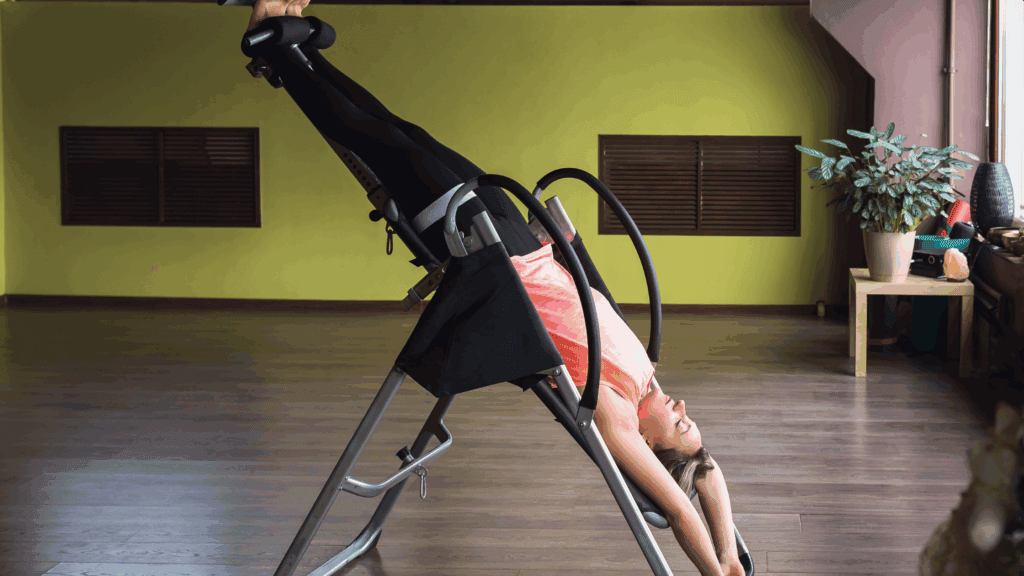
An inversion table is a device that allows a person to hang partially or completely upside down while secured by the ankles. The main idea behind using an inversion table is to relieve pressure on the spine. By turning the body upside down, gravity gently pulls the spine in the opposite direction of normal compression. This creates a stretching effect like what doctors call traction or spinal decompression, terms that are often used interchangeably.
What Is Spinal Decompression or Traction?
In everyday life, gravity constantly pushes down on the spine. Over time, this pressure can cause the spaces between the spinal bones (called vertebrae) to narrow. The soft discs between those bones may bulge, flatten, or develop small tears known as fissures. This can lead to back pain, stiffness, and even nerve symptoms like tingling or numbness in the legs.
Traction and decompression both work by stretching the spine to temporarily reduce the pressure between the vertebrae. When this happens, the discs have more room to absorb nutrients and fluids, which can help them stay healthier. Traction may also relieve nerve pressure and muscle tension.
Why People Use Inversion Tables
The main advantage of an inversion table is convenience. You can use it at home without having to go to a clinic or see a specialist. Instead of relying on a therapist or machine to provide traction, you can simply tilt yourself backward on the table to create the same stretching effect. Many people use inversion tables hoping to reduce back pain, relax tight muscles, improve posture, or feel more flexible.
However, the same convenience that makes inversion tables appealing is also what makes them potentially risky. Because you are fully in control, there is no professional supervision to make sure you are using it safely or for the right reasons.
Important Safety Concerns
Before trying an inversion table, it is essential to understand that the human body was not designed to be upside down for extended periods. Hanging at an angle or fully inverted changes how blood and pressure move through the body.
When you are upside down, blood rushes toward your head and eyes, increasing pressure inside the skull and the eyeballs. This can be dangerous for people with glaucoma, high blood pressure, heart disease, or circulation problems. The increased pressure can also strain the heart because it must work harder to pump blood against gravity.
The digestive system can also be affected. Acid from the stomach may move upward, causing discomfort or reflux. For these reasons, it is particularly important to talk to a healthcare provider before using an inversion table, especially if you have any medical conditions.
Safety Precautions
If you do decide to use an inversion table, take precautions to stay safe.
– Never use it alone. Have another person nearby who can help you return to an upright position if something goes wrong.
– Make sure you are securely fastened, and the table is on a flat, stable surface.
– Start slowly—a gentle angle of 20–30 degrees may be enough to feel the stretching effect without causing dizziness or strain.
– Keep a phone within reach in case you need help. Some users have been stuck in the inverted position due to a table malfunction or loss of strength.
The Benefits of Traction
When used carefully, traction or decompression can offer some benefits. It may temporarily reduce pressure inside the spinal discs, relieve nerve irritation, and ease muscle spasms. Some people report short-term relief of back pain after using an inversion table or receiving traction therapy.
However, it is important to understand that the benefits are temporary. Once the person stands upright again, gravity quickly restores normal spinal pressure. The underlying disc damage or degeneration that caused the pain in the first place remains unchanged.
Treating Symptoms vs. Fixing the Cause
Using an inversion table is like treating the symptoms of back pain. It may help you feel better for a little while, but it does not fix the structural problem. Most chronic low back pain comes from damage in the spinal discs, such as bulges, protrusion, herniations, extrusions or small tears (fissures) in the outer layer of the disc, called the annulus fibrosus.
Over time, these fissures allow the inner disc material to lose fluid and strength, leading to degeneration and pain. Stretching the spine does not seal these fissures, rather, it only reduces the pressure temporarily.
A New Option: The DISCSEEL® Procedure
To actually repair the underlying problem, a new nonsurgical treatment called DISCSEEL® has been developed. Instead of cutting or removing parts of the spine, DISCSEEL® involves injecting a biologic material called fibrin into the damaged discs. Fibrin is a natural protein that helps tissues seal and heal.
Once injected, fibrin fills the small fissures in the disc’s outer wall, helping the disc hold fluid again and function more normally. Unlike traction or inversion therapy, which only provide short-term relief, DISCSEEL® aims to correct the disc’s structure, which addresses the root cause of pain rather than just the symptoms. Contact the Regenerative Spine & Joint Center today to find out if your lumbar spine condition will benefit from DISCSEEL®.
The Bottom Line
Inversion tables can be a convenient way to experience the effects of spinal traction at home. When used carefully and with proper medical guidance, they can provide temporary relief from back discomfort. But they also come with real risks, especially for people with heart, blood pressure, stroke, or eye conditions.
It is important to view inversion therapy as one of many tools for managing back pain, but it is not a cure. For lasting improvement, treatments that repair the structure of the damaged disc, such as the DISCSEEL® procedure, may offer a more complete and lasting solution.
Inversion tables can help you feel better for a short while, but true healing comes from addressing the cause of disc damage instead of just stretching the symptoms away.