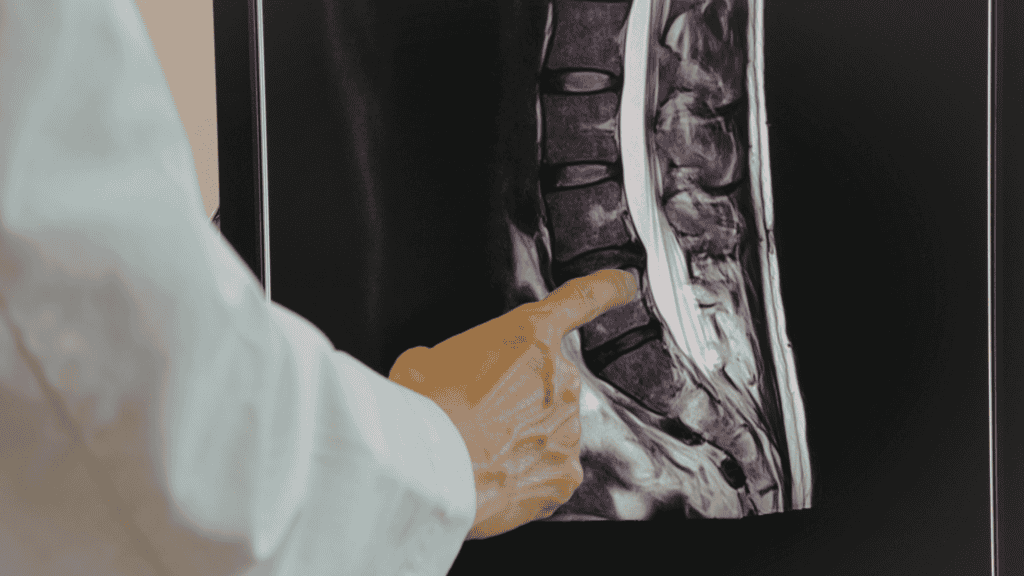
Low back pain is one of the most common medical problems in adults. A major cause of chronic low back pain is degenerative disc disease, a condition where the spinal discs gradually lose their structure and function. In recent years, new minimally invasive treatments have been developed to address disc degeneration more directly. Two examples are VIA Disc NP and Discseel.
To understand how these procedures work, it is helpful to first understand the anatomy of the spinal disc and how degenerative disc disease develops.
Anatomy of the Lumbar Disc
Each disc in the lumbar spine sits between two vertebral bones and acts as a shock absorber. The disc has two main parts:
1. Nucleus Pulposus (NP)
The nucleus pulposus is the soft, gel-like center of the disc. Its main functions are:
- Absorbing compressive forces
- Maintaining disc hydration
- Allowing flexibility in spinal movement
- Distributing mechanical loads across the spine
The nucleus is rich in water, proteoglycans, and collagen.
2. Annulus Fibrosus (AF)
The annulus fibrosus is the tough outer ring of the disc. It consists of multiple layers of strong collagen fibers arranged in a circular pattern.
The annulus has several roles:
- Containing the nucleus pulposus
- Providing structural strength
- Stabilizing the spinal segment
- Resisting twisting and bending forces
Together, these two components allow the spine to move while also protecting the vertebrae from mechanical stress.
How Disc Degeneration Develops
Disc degeneration usually begins in the nucleus pulposus. According to information on the official VIA Disc NP website, “disc degeneration typically begins within the nucleus pulposus… [which] begins to lose its ability to absorb water and nutrients.”
As the nucleus loses hydration, several changes occur:
- The disc becomes thinner
- Shock-absorbing ability declines
- Mechanical stress on the annulus increases
Over time, the annulus fibrosus develops small tears or fissures. These annular tears can cause pain because nerve fibers are located in the damaged annulus. Degeneration therefore involves both the nucleus and the annulus, even though the process often begins in the nucleus. It is important to appreciate, though, that disc pain begins when fissures in the annulus start to form.
Because the two structures are interdependent, deterioration in one component can accelerate degeneration in the other.
What Is VIA Disc NP?
VIA Disc NP is a minimally invasive intradiscal biologic therapy designed to restore function of the nucleus in a degenerating lumbar disc.
The treatment uses a processed human tissue graft derived from donated nucleus pulposus tissue. According to the official website: “VIA Disc NP is the first and only nucleus pulposus (NP) allograft intended to support the cushioning function of the intervertebral disc and supplement a patient’s tissue loss.”
The therapy attempts to replace lost or damaged nucleus pulposus tissue.
How the VIA Disc NP Procedure Works
During the procedure:
- The patient lies on an X-ray table.
- Using fluoroscopic imaging, a needle is guided into the disc.
- The needle passes through a region called Kambin’s triangle to reach the center of the disc.
- The VIA Disc NP graft is injected into the nucleus pulposus.
As described by the manufacturer:
“The VIA Disc NP procedure is intended for patients who have experienced tissue loss within the lumbar intervertebral discs.”
Once injected, the graft is intended to support disc nucleus hydration and restore mechanical cushioning.
Conditions Treated by VIA Disc NP
VIA Disc NP is primarily used for lumbar discs with nucleus degeneration. Candidates usually have:
- Chronic low back pain lasting months or years
- MRI evidence of degenerative discs
- Reduced disc height or hydration
- Limited improvement with conservative treatments
Patients typically try other therapies first, such as:
- Physical therapy
- Medications
- Epidural steroid injections
The goal of VIA Disc NP is to restore disc nucleus function rather than simply mask pain.
What Is Discseel?
Discseel is also a minimally invasive spinal procedure. However, its strategy is different from VIA Disc NP.
Discseel uses a fibrin sealant injected into the disc to seal tears in the annulus fibrosus. Fibrin is a biological protein involved in healing. The injected fibrin sealant fills annular fissures and may stimulate tissue healing.
Instead of replacing nucleus tissue, Discseel focuses on repairing the outer ring of the disc where the pain generators are located.
Treatment Strategy: VIA Disc NP vs Discseel
Although both procedures treat disc degeneration, they target different parts of the disc.
VIA Disc NP Strategy
Primary target: Nucleus pulposus
Goals:
- Replace lost nucleus tissue
- Restore disc hydration
- Improve cushioning and load distribution
- Reduce mechanical stress on the annulus
This strategy assumes that nucleus degeneration is the primary driver of the disease.
Discseel Strategy
Primary target: Annulus fibrosus
Goals:
- Seal annular tears
- Prevent leakage of inflammatory nucleus material
- Reduce nerve irritation
- Stabilize the disc structure
This strategy assumes that annular tears are the main source of disc pain.
Which Part of the Disc Is More Important?
Degenerative disc disease involves both components of the disc, but the sequence often follows this pattern:
- Nucleus dehydration and breakdown
- Increased mechanical stress on the annulus
- Annular fissures and tears
- Disc height loss and instability
Because the annulus and nucleus work together, treatments targeting only one component may not fully restore disc health.
Can the Annulus Heal If Only the Nucleus Is Treated?
If VIA Disc NP restores disc height and hydration, the mechanical load on the annulus may decrease. This might allow some stabilization of annular fissures.
However, the annulus has poor blood supply, which limits its healing ability. Spontaneous repair of annular tears is therefore unpredictable and often incomplete. Once the fissures are present, they typically never heal, instead they advance in size and number as time passes.
Thus, while VIA Disc NP may reduce stress on the annulus, it does not directly repair existing annular tears. As a result, disc pain can persist even after the nucleus pulposus is treated.
Can the Nucleus Recover If Only the Annulus Is Treated?
If Discseel successfully seals annular tears, several things may occur:
- Inflammatory chemicals may stop leaking from the nucleus
- Mechanical stability may improve
- Pain may decrease
However, the procedure does not directly restore lost nucleus tissue. However, when a disc is no longer actively leaking through annulus fissures, progressive nucleus dehydration is mitigated.
Why Doesn’t VIA Disc NP Leak Out of the Disc?
A common concern is whether injected material might escape through the persisting annulus fissures.
Several factors help prevent leakage:
- Controlled injection pressure
- Viscous gel consistency of the graft
- Small injection volumes
- As long as outer annulus layers are still intact
Comparing the Indications
VIA Disc NP Indications
Best suited for:
- Mild to moderate degenerative disc disease
- Loss of nucleus hydration
- Intact or mostly intact annulus
- The most appropriate candidates for VIA Disc NP have disc degeneration but without annulus fissures. Ironically, discs may not become painful until after annulus fissures form.
Discseel Indications
Best suited for:
- Annular tears or fissures
- Pain caused by annular nerve irritation: “Leaky Disc Syndrome”
- Disc instability caused by annular damage
Conclusion
VIA Disc NP and Discseel represent two different biological strategies for treating degenerative disc disease.
VIA Disc NP focuses on replacing lost nucleus pulposus tissue and restoring the disc’s shock-absorbing ability. Discseel focuses on repairing tears in the annulus fibrosus to stabilize the disc and reduce inflammation.
Because degeneration typically begins in the nucleus but later affects the annulus, the ideal treatment may depend on which structure is the dominant source of the patient’s pain. The most important fact to emphasize is that disc annulus fissures are the more likely source of discogenic pain. By the time a person experiences low back disc pain, their disc condition has likely progressed past the ideal window for VIA Disc NP treatment – which is when the disc annulus is still intact. Therefore, treating the nucleus pulposus alone with VIA Disc NP in the presence of annulus fissures typically results in persisting disc pain.
In patients whose main problem is loss of nucleus hydration, VIA Disc NP may be the more logical treatment. In patients whose main problem is annulus fissures, Discseel is most appropriate. By the time lumbar disc pain manifests, annulus fissures are likely already present. During a Discseel procedure, an annulogram is performed, which identifies annulus fissures when they may not be visible on MRI.
Contact the Regenerative Spine & Joint Center to find out if your lumbar degenerative disc disease condition will benefit from Discseel.